WeatherGrrrl is today starting down the difficult road of recovering from knee replacement surgery. Being modern folk, we’d counted on wireless in the hospital to allow Netflix to be a key mental narcotic, helping keep her mind off the pain that unavoidably comes of having bones reshaped with saws, ligaments removed, and various other tissue … Continue reading "Value vs. worth (again)"]]>
Warning: Undefined array key "HTTP_REFERER" in /home/unhinder/www/www/Phi/wp-content/plugins/google-hilite.php on line 58
Turns out that this hospital is really quite wonderful. The staff have been splendid and caring, she has a very nice room to herself, and they have treated me as a real part of the process and not just a mildly annoying guy in the way.
So, really wonderful. Except that the guest wireless doesn’t seem to reach her room. It’s great in the lobby. It’s great here in this family room. But her hospital room appears to eat radio signals, as neither wifi or cell seem to penetrate that space reliably.
As a result I suggested that we buy a film or similar for the iPad to help make up for the Netflix shortfall, and came here to the family room to download Thor as a bit of distracting popcorn.
And it was $20.
Which gave me pause.
Which in turn really made me annoyed with myself.
So far today I’ve spent that much on meals. We’ll certainly spend that much on gas back and forth for this procedure. It’s a fraction of our minuscule share of the huge bill this will rack up. (We are very grateful for the University’s excellent health care plan.) Or we could compare this to the cost of Thomas’s tuition at Hampshire. Or my soda pop habit at the office. Or money I lose under the bed.
JOCP!!! What was I thinking? Why did I even remotely care? If this film gives her even an hour of distracted relief from the mending and tearing going on in her leg it’s totally worth it! And, I’m quite sure it will do more than that.
I realize that there’s a lot of privilege assumed in this, and that there are people for whom that $20 would be a genuine concern. (& way too many for whom an operation like this would be out of reach.)
But that’s not us.
And I just spend the best $20 I’m likely to spend in a very long time.
]]>A great 2.5 minute “big picture” view of what’s wrong with the U.S. economy: In short, we’re being played, peeps. A small number of very wealthy folks have rigged the system in their favor and trashed the economy in the process. The amazing thing is how thoroughly they’ve convinced the middle class to support them … Continue reading "The big picture of what’s wrong with the economy"]]>
Warning: Undefined array key "HTTP_REFERER" in /home/unhinder/www/www/Phi/wp-content/plugins/google-hilite.php on line 58
In short, we’re being played, peeps. A small number of very wealthy folks have rigged the system in their favor and trashed the economy in the process. The amazing thing is how thoroughly they’ve convinced the middle class to support them as they’ve smashed up the family china. They have only a few votes, and their power rests ultimately in their ability to buy and bully ours.
Sadly, a culture that values sound bites more than data and rational discussion is ripe for this kind of abuse. It’s probably no accident that these people are so intent of gutting our schools, as it just serves their short term goals. Ultimately, though, they need a solid middle class to buy their toys, so this can’t be a good long-term strategy for anyone.
]]>Segregating information by its mode of production, convenient and profitable for software houses, too often becomes a corrupting metaphor for evidence presentations. Why should the intellectual architecture of our reports and evidence reflect the the chaos of software bureaucracies producing those reports? — Edward Tufte, Beautiful Evidence, p. 61]]>
Warning: Undefined array key "HTTP_REFERER" in /home/unhinder/www/www/Phi/wp-content/plugins/google-hilite.php on line 58
Segregating information by its mode of production, convenient and profitable for software houses, too often becomes a corrupting metaphor for evidence presentations. Why should the intellectual architecture of our reports and evidence reflect the the chaos of software bureaucracies producing those reports?
— Edward Tufte, Beautiful Evidence, p. 61
]]>And the day after I get around to posting this, he announces that he’s not running after all. Sigh. The reasons he gives in his new video are clear and convincing, however, and there’s always the possibility that he might run in the future when the notice is not so short. It’s probably old news … Continue reading "It’s worth 10 minutes of your time"]]>
Warning: Undefined array key "HTTP_REFERER" in /home/unhinder/www/www/Phi/wp-content/plugins/google-hilite.php on line 58
It’s probably old news for some of you that Lawrence Lessig is considering running for Congress, but I only just had time to watch Lessig’s video, and I definitely want to put in a plug for it, and for him, and for his possible campaign. Lessig has written some excellent books (Arne Kildegaard and I have used both Free culture and The future of ideas in our interdisciplinary network economics course), and is a wonderfully clear thinker with a powerful grasp of what’s necessary to effect change (rather than just make noise). (He’s been a key player in the Creative Commons movement, for example.)
I couldn’t claim to have done the sort of homework needed to make any concrete statements on his policies or particulars, but I can say that he’s a smart, effective guy who’s trying to address real and important problems. And that seems to be a pretty good pedigree for someone running for Congress. I quite like the message of the video as well, and think it would be quite fascinating to see him take on an extremely experienced and successful (his words) politician.
I’m also impressed by his willingness to actually stick his neck out, because I know that I find that hard. I’ve thought, for example, about running for school board in Morris, but I’ve never quite screwed up the courage to try it. It’s obviously very important, and I care a lot about (and frequently disagree with) the Board’s actions. I also know, however, that it would take a lot of time to do well, and probably be pretty frustrating (you’ll never make everyone happy, and there’s likely to be a shortage of easy answers). Thus nothing has actually happened (at least so far).
So well done to Lessig, and best wishes.
]]>I keep going on about how hard it is for well meaning people to make good decisions without accurate feedback, and this video has a nice way of visualizing the problem. Now if I could just get all our appliances to make balloons like that… Coin operated gas meters were common in the UK for … Continue reading "It would be helpful if our hot water heater produced black balloons"]]>
Warning: Undefined array key "HTTP_REFERER" in /home/unhinder/www/www/Phi/wp-content/plugins/google-hilite.php on line 58
I keep going on about how hard it is for well meaning people to make good decisions without accurate feedback, and this video has a nice way of visualizing the problem. Now if I could just get all our appliances to make balloons like that…
Coin operated gas meters were common in the UK for many years, and in some ways it would be nice to return to something like that. It would make you think a second before automatically hitting that light switch when you enter a room, and it would certainly encourage you to turn the damn thing off when you leave. We still haven’t gotten a bill from all the utilities we’re connected to here in the UK, and we went months with absolutely no feedback on our energy consumption. If there’d been little meters on everything, we would have very quickly learned where the big energy sinks were. As it is, we’ll probably never really know.
It’ll obviously never happen, but I can dream.
Thanks to Tim O’Reilly for the pointer.
]]>The death of the book has been oft prophesied, and so far the old dear keeps hanging in there. Here Bill Janssen is quoted by Peter Brantley, suggesting that what the casualties may be are forms of content rather than forms of publishing. Will the novel become a marginal form like opera? In the hype … Continue reading "Twilight of the novel?"]]>
Warning: Undefined array key "HTTP_REFERER" in /home/unhinder/www/www/Phi/wp-content/plugins/google-hilite.php on line 58

The death of the book has been oft prophesied, and so far the old dear keeps hanging in there. Here Bill Janssen is quoted by Peter Brantley, suggesting that what the casualties may be are forms of content rather than forms of publishing.
Will the novel become a marginal form like opera?
]]>In the hype around the Kindle, I haven’t noticed a mention of Monday’s NEA report, To Read or Not To Read. Seems much more interesting.
I’ve been saying for a few years that we are entering an age where textual fiction is becoming less and less significant, particularly for the canonical long text, the novel. The novel is a relatively recent innovation in entertainment, and the popular novel is a product of cheap production and distribution, thanks to the industrial revolution.
The delivery channels have multiplied, and the economics have changed. Television killed off the pulp magazine (and crippled the market for short stories). What would replace the novel? Something which would produce a ludic experience for hours at a time — a movie. But movies have not succeeded in killing off the novel. They’re too expensive and too complicated, and major players control the distribution channels. The best they could do was to absorb years of talents like Chandler and Faulkner.
But now we have kids who don’t read, the Web, game engines, and the writers’ strike. Game engines and machinima make it possible for writers to produce and direct their own work without actors or sets, for a relatively modest capitalization (a game machine). The Web provides free distribution. Kids provide a hungry audience. But the wild card here is the WGA strike. Suddenly all the folks who normally spend their days creating teleplays are looking for other outlets for their creative energies. Maybe write that novel they’ve been talking about? Maybe not. People like Rob Long (Cheers) are suddenly blogging. Maybe someone will tell them about machinima. We may be entering a twilight for the popular novel, perhaps relegating it to a niche more like opera.
I just discovered The Gapminder, a very cool visualization tool created by Hans Rosling and others. It gives you the ability to visualize changes in a variety of socio-economic indicators across both space and time, with particularly effective use of simple animations across the time dimension. It’s really cool to play with, and there are … Continue reading "The power of good visualization"]]>
Warning: Undefined array key "HTTP_REFERER" in /home/unhinder/www/www/Phi/wp-content/plugins/google-hilite.php on line 58
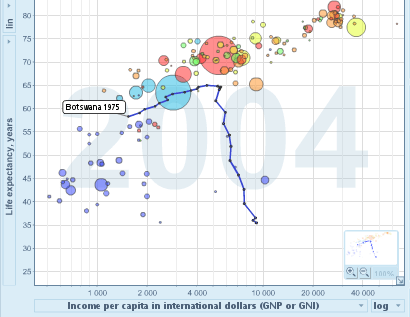
I just discovered The Gapminder, a very cool visualization tool created by Hans Rosling and others. It gives you the ability to visualize changes in a variety of socio-economic indicators across both space and time, with particularly effective use of simple animations across the time dimension.
It’s really cool to play with, and there are a lot of things you can change that aren’t immediately obvious (I found the short demo in the on-line help quite helpful). You can certainly learn a lot by goofing around with it (as well as generate a lot of meaningless visual noise). The screenshot above is from a plot of life expectancy vs. per capita income over time (the default plot you get when you start it up). I had to watch it a few times to sift out some trends, but after getting past the obvious “generally, more money means longer life” I realized that lots of blue bubbles (i.e., African countries) were “falling” out of the cloud at the end like particulates settling out of a liquid. This indicates that their life expectancy has plummeted in the last few years, which is obviously not the right direction. Why? Almost certainly the continuing AIDS crisis in large parts of Africa, and visualizations like this make it painfully (literally) obvious that this must be cause for serious concern.
In the graph above, I’ve highlighted Botswana,which shows a particularly depressing case. Both their life expectancy and per capita incomes were moving in a happy direction until the early 90’s when, despite continued gains in per capita income (which I’d like to know more about), their life expectancy flew the wrong direction.
Take a second to think about the enormous human suffering a change like that implies.
Thanks to John Hawks for the pointer. Hawks points out that the use of circles of different areas probably isn’t a great way to visualize quantitative differences (a general point Tufte raised years ago), but Rosling’s going for quick impact rather than quantitative precision:
So far, we have had a major hit with two target groups: children under 12 and heads of state. What they have in common is that you have only 5 to 10 seconds to impress them.
(You just have to love the reality that you need the same tools to communicate with little kids and world leaders. Maybe we should just put the little kids in charge? They might have more empathy.)
One thing that really annoyed me when I wrote this post was the fact that you can’t easily embed these graphs in a web page. I don’t think I’d really appreciated how used I’d grown to being able to embed images, video, maps, slideshows, and the like in blog posts. I think embedding has become absolutely key to the success and mass propagation on the web, and people designing new tools (or updating existing ones) better keep that in mind.
]]>OpenCongress has a nice piece on what a sham Our Fearless Leader’s blather about “fiscal responsibility” is. I’ll send you there for the text, but the short version is (not surprisingly) this isn’t about responsibility at all, it’s about priorities and (lack of vision) in the White House. He’s happy to spend inordinate amounts of … Continue reading "He never was very good at
Warning: Undefined array key "HTTP_REFERER" in /home/unhinder/www/www/Phi/wp-content/plugins/google-hilite.php on line 58
To provide some perspective, we’re spending hundreds of billions on this poorly conceived, poorly planned, dishonest and corrupt mess in Iraq, killing huge numbers of Iraqi people and American soldiers in the bargain. The entire annual budget of UMM is well under $100M, a factor of something like 1/1000. It’s thus absolutely obvious that we could ensure that everyone in the U.S. who wanted to go to college could do so for free, entirely on the Fed’s dime. It is not about resources, it is about choices.
Another take on this is illustrated by the amazing (but very large) graph from SolarPowerRocks.com below the fold, which makes it painfully clear how little the administration really cares about energy independence and planning for the future of our country and our planet.
Selfish, foolish bastards, frankly. Selfish, foolish bastards.
