Warning: Undefined array key "HTTP_REFERER" in /home/unhinder/www/www/Phi/wp-content/plugins/google-hilite.php on line 58

In a desperate bid to not to be outdone by our amazing progeny, Sue and I will be hanging our first collaborative art show next week at the Prairie Renaissance Cultural Alliance (PRCA) Gallery! The kind folks at the PRCA actually approached us about doing a joint show last year; there really wasn’t time to put it together then, but we agreed to do something this year.
In many ways the “simple” approach would have been a combination of Sue’s recent sculpture and my photography. We really wanted this to be a collaboration, though, and over the course of the year we worked together on a collection of photographs documenting her use of her body (in particular her head) as a canvas. Thousands of photographs were taken (over 7,000 in a single three month period!), forming the source material for the pieces that we’ll be hanging. Sue laid out the tableaus, I shot the hell out of them, and then we worked together to figure out what images to use and how.
Portraiture is one of the oldest of artistic disciplines, often providing an “objective” (or at least objectifying) view of the individual. These images examine an artist, Susan Gilbert, at work, capturing her use of her own head as canvas. Some of the photographs are disconcerting both in their underlying subject, and in their focus and presentation. Some are overtly political in their content, while all comment on how we see those around us and respond to change. No single image is the “true portrait” of the artist; they are all fragments of a whole, distorted by the cultural lens through which they are viewed.
The show includes the biggest photographic prints we’ve ever made (the largest is 60″x40″) and it’s quite something to see the work (and Sue’s head) that huge! We also have a diptych of collages that are 6 feet tall and together over 8 feet wide, so we definitely decided to “Go big or go home!”.
We’ll hang the show next Saturday (8 Feb) and the show will open on the 12th. There will be a reception at the gallery on Sunday, 16 Feb, from 7-8:30pm, where you’ll be able to publicly question our sanity while eating nummy snacks!
]]>You try to live your life like you used to, and the “used to” isn’t there. It’s gone. Gulp. This is an incredible five minute piece combining beautiful still photography, video, and audio, that in a few short minutes captures the depth of love and the tragedy of loss in the life of Tom Rose, … Continue reading "A life alone: An incredibly powerful short video"]]>
Warning: Undefined array key "HTTP_REFERER" in /home/unhinder/www/www/Phi/wp-content/plugins/google-hilite.php on line 58
You try to live your life like you used to, and the “used to” isn’t there.
It’s gone.
Gulp.
This is an incredible five minute piece combining beautiful still photography, video, and audio, that in a few short minutes captures the depth of love and the tragedy of loss in the life of Tom Rose, who is struggling to cope with the loss of his wife of 63 years. It is a form of multi-media poetry, powerfully distilling decades of life and experience into a frame or a sob.
Be warned – it’s not an easy watch. It is, in the end, a scary dark patch in all of our lives, and the lives of those we love and care for; a price we pay for the joy of being together is the pain of being apart.
Big props to Maisie Crow for such a fine piece of work. Every part of it is quite something, and together the pieces pack an enormous emotional wallop. And thanks to FlakPhoto for bringing it to my attention.
]]>Actually, I helped a piece of Jess Larson’s wonderful art become the central component of a book cover, but let us not quibble. As patient, long-time readers might know/remember, Jess Larson makes very cool art, including a fantastic series of girdles from several years back. There was a showing of her girdles at the PRCA … Continue reading "I’ve become a book cover!"]]>
Warning: Undefined array key "HTTP_REFERER" in /home/unhinder/www/www/Phi/wp-content/plugins/google-hilite.php on line 58

Actually, I helped a piece of Jess Larson’s wonderful art become the central component of a book cover, but let us not quibble.
As patient, long-time readers might know/remember, Jess Larson makes very cool art, including a fantastic series of girdles from several years back. There was a showing of her girdles at the PRCA back in 2006, and I had the chance to carefully photograph the show, posting many of the results on Flickr.
Zip ahead several years, and one of these photos caught the eye of the folks at Caketrain as they were looking for ideas for the cover of a new book they were publishing: Tongue party by Sarah Rose Etter. Some e-mails were traded, etc., etc., and Jess and I both happily agreed to have our work (her girdle, my photo of it) used for their cover.

One of the unexpected little treasures that was waiting for us when we got home from Arkansas this week was my copy of the book, and the cover (pictured above) is really wonderful. I love the texture they added as the background and the way they’ve incorporated the text. I haven’t actually read the thing yet, but the pre-press blurbs certainly sound wonderful and I look forward to adding it to my summer reading list!
Thanks to Jess for making such cool art, giving me such nifty things to take pictures of, and being generous about the use of her art in this new context. Thanks also to the kind folks at Caketrain for seeing the work and getting in touch, and for making such a cool cover out of it all. This is another neat example of the value of sharing work on-line with tools such as Flickr; without that none of this would have been possible. I’m not getting paid anything beyond my free copy of the book, but now a whole new set of people will see Jess’s art and my photography, and that’s quite fine in my humble opinion.
]]>Not as part of an art exhibition, to be fair, but it is an art gallery, and I’m easily excited :-). As mentioned earlier, I submitted a number of photos for consideration in a call for art for UMM’s new Welcome Center. Much to my delight two photos were in fact chosen, being I think … Continue reading "Eeeek! I have photos hanging in an art gallery!"]]>
Warning: Undefined array key "HTTP_REFERER" in /home/unhinder/www/www/Phi/wp-content/plugins/google-hilite.php on line 58

As mentioned earlier, I submitted a number of photos for consideration in a call for art for UMM’s new Welcome Center. Much to my delight two photos were in fact chosen, being I think the first two pieces of mine to ever be purchased as art (as opposed to illustration or journalism). The first is the train panorama above, and the second is the turbine shot below.

Michael Eble (the curator for UMM’s HFA Gallery) also asked if he could exhibit four other photos (below) that I submitted in the 2010 Celebration exhibition in the HFA Gallery! They’re hanging now (in the upper level down at the end). There will be special showings during Founders Weekend, September 23–26 and Homecoming Weekend, October 8–10, and the exhibit closes on 16 October.
 |
 |
 |
 |
The University of Minnesota, Morris, recently open its new Welcome Center, a major renovation of what had become a sad little building into a shining, spiffy new space. Among other things, it’s a real tribute to the campus’s commitment to sustainability: When certified, the Welcome Center will be the first LEED Platinum building in the … Continue reading "Computer Scientist foolishly submits photography to art jury for campus building (no film anytime soon)"]]>
Warning: Undefined array key "HTTP_REFERER" in /home/unhinder/www/www/Phi/wp-content/plugins/google-hilite.php on line 58
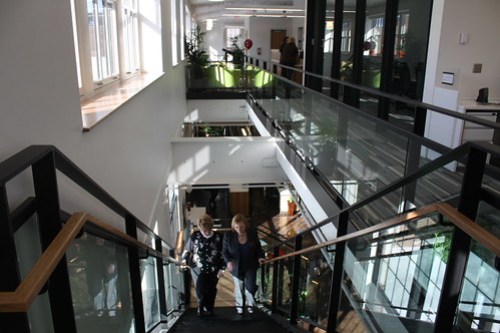
The University of Minnesota, Morris, recently open its new Welcome Center, a major renovation of what had become a sad little building into a shining, spiffy new space. Among other things, it’s a real tribute to the campus’s commitment to sustainability:
When certified, the Welcome Center will be the first LEED Platinum building in the University of Minnesota system; the first LEED Platinum building on the National Register of Historic Places; and one of only thirteen higher education LEED Platinum certified buildings in the world. The Welcome Center is also the first building in Minnesota to use energy efficient chilled beam technology.
They’ve put out a call for art for the building, with a particular interest in work from alumni and others connected to the campus. In a foolish moment, I’ve submitted 20 photos. Now we wait and see if they want to purchase any of them!

Mom Loves Me, originally uploaded by nailbender. I don’t get enough time to look at the wonderful photos that other people are posting on Flickr, but every now and then I carve out a few minutes. This morning over breakfast I discovered this gem and had to share. There is so much to like about … Continue reading "Mom Loves Me"]]>
Warning: Undefined array key "HTTP_REFERER" in /home/unhinder/www/www/Phi/wp-content/plugins/google-hilite.php on line 58

I don’t get enough time to look at the wonderful photos that other people are posting on Flickr, but every now and then I carve out a few minutes. This morning over breakfast I discovered this gem and had to share. There is so much to like about this: The cool and unexpected subject matter, the generous treatment, the wonderful lighting and color, the tilt of the mother’s head. So, so nice. Well done to nailbender and thanks a ton for sharing!
]]>Flickr’s Uploadr is fine for small uploads, but tends to die consistently and unpleasantly when I have several hundred photos to upload, like those from Thursday’s opening of “The boys next door”, this year’s Morris Area High School one-act. It almost always takes me several tries to get a large pool of photos uploaded, which … Continue reading "Flickr Uploadr is a pain, but Flickraw saved the day"]]>
Warning: Undefined array key "HTTP_REFERER" in /home/unhinder/www/www/Phi/wp-content/plugins/google-hilite.php on line 58

Flickr’s Uploadr is fine for small uploads, but tends to die consistently and unpleasantly when I have several hundred photos to upload, like those from Thursday’s opening of “The boys next door”, this year’s Morris Area High School one-act. It almost always takes me several tries to get a large pool of photos uploaded, which is a pain, but not fatal. This time, however, it chose to upload them in a semi-random order, so then it died I had 80-ish photos scattered all across the show, which meant I couldn’t just delete the first K from the list and restart the upload. Ugh.
Because it was late and I was in a hurry, I ended up just uploading the whole set (over several attempts), but marked them as private so people wouldn’t end up seeing two copies of that first group of images, figuring I’d sort things out in the morning.
The morning came, and it turned out that I really didn’t have a workable plan. All the pictures were on Flickr, but there was no good (i.e., automated) way to figure out which were the duplicates. If I could identify them, then deleting the duplicates and making the rest visible would be easy, but I didn’t have a clue how to find the duplicates using Flickr’s tools.
Sigh.
This would, however, be pretty straight forward in a script if I had all the data I needed, and this is where Flickr redeemed itself. They have a very rich API for accessing (and modifying) photos and their associated information (like tags), so if I could figure out how to use that I’d be golden. I’d poked a little with some Ruby Flickr libraries in the past, but none of them ever seemed very complete and they were always struggling to stay on top of Flickr’s changes and extensions to the API. A little searching this time, however, turned up Flickraw, which uses some really nifty Ruby metaprogramming to essentially build the Ruby part of the API “on the fly”, ensuring that it will be complete and up-to-date all automagically!
It turns out that Flickraw was indeed powerful, flexible, and easy to use. After authenticating (following the example on the Flickraw web site), I was able to use it to pull down a list of all the photos from “The boys next door”
my_owner_id = "68457656@N00"
play_title = "The boys next door"
my_stream = flickr.photos.search(
              :user_id => my_owner_id,
              :text => play_title,
              :per_page => 500)
I then split that list into the initial set of publicly visible photos, and the photos I’d uploaded after things got screwy and kept private (i.e., visible only to me):
public_photos = my_stream.find_all {|photo| photo.ispublic == 1}
private_photos = my_stream.find_all {|photo| photo.ispublic == 0}
My next task was to determine which of the private photos were duplicates of one of the public photos people were already looking at. All I really needed was the list of duplicates, but I decided to create lists of both the duplicates and the non-duplicates. I had to compare titles here because the Flickr IDs would be different; as far as Flickr knew they were all different photos. Happily, I had named them in a way that they each had a unique title, so if two photos had the same title, I knew they were the same shot uploaded twice.
dups = []
non_dups = []
private_photos.each do |photo|
  public_duplicate = public_photos.find { |pub| photo.title == pub.title }
  if public_duplicate
    dups.push(photo)
  else
    non_dups.push(photo)
  end
end
At this point, I could apply tags to all the photos in the two groups, and all the rest of the fiddling could be done through Flickr’s web tools:
non_dups.each do |photo|
  flickr.photos.addTags(:photo_id => photo.id,
                        :tags => "to_keep")
end

dups.each do |photo|
  flickr.photos.addTags(:photo_id => photo.id,
                        :tags => "to_delete")
end
I could have actually done everything with the Ruby script (delete the duplicates, change the remaining images to publicly visible, and add them to the appropriate set), but wanted to do that via Flickr so I could see what was happening as I went. And once the tags were in place, the work in Flickr was quite straightforward. The result: A set of 339 images that contains all the photos I uploaded, with no duplicates, all accomplished without deleting any of the original uploads.
Big thanks to Maël Clérambault, the author of Flickraw, for his excellent little library, and thanks to Flickr for providing this very nice set of API calls. (Now go fix Flickr Uploadr, damnit!)
As for the play – I just heard that they took second at today’s sub-sections competiton, which means they move on to sections next week, and Tom got a star performance award! Congratulations all!
]]>Another from that gorgeous sunset behind the wind farm at Buffalo Ridge (near Lake Benton, MN). KK and I got off US 75 on Norwegian Creek Road, which is what’s heading off in front of us here. The GPS, which was a bit confused about our little photo detour, actually suggested we continue down this … Continue reading "Traveling through time (and figuring out a few new things about RAW)"]]>
Warning: Undefined array key "HTTP_REFERER" in /home/unhinder/www/www/Phi/wp-content/plugins/google-hilite.php on line 58

Another from that gorgeous sunset behind the wind farm at Buffalo Ridge (near Lake Benton, MN).
KK and I got off US 75 on Norwegian Creek Road, which is what’s heading off in front of us here. The GPS, which was a bit confused about our little photo detour, actually suggested we continue down this gravel road and wander the backroads for a while. After breaching a few snow drifts across the road, we decided this wasn’t such a great idea in extremely cold weather with night fast coming on. We turned around and made it back to the blacktop safe and sound, and remained on more substantial roads the remainder of the journey.
I’ve often struggled with different ways of pulling out the useful information in both strong highlights and deep shadows, but somehow in all these photos I’d never learned (or figured out on my own) about multi-RAW processing. RAW is really nice and gives you a ton of flexibility, even though it takes up a lot more space. There’s a lot of great data there, but you have to learn to use it. I’d figured a lot of stuff out by just digging around in Photoshop and on-line, but somehow I’d totally missed this multi-RAW idea. I got a copy of The Photoshop darkroom for Xmas, however, and it’s really opened my eyes to some possibilities I’d been missing before.
Here I essentially pulled two images from the raw data on the camera. One was adjusted for the sky (keep the exposure down to saturate those great colors), and the other for the ground (crank up the exposure so you get some detail in the road and the snow). Then you lay those two versions on top of each other, and use a mask to merge them. It look a reasonable amount of futzing (maybe an hour, but I was fairly new to the whole masking thing), but the result was far cooler than I could have gotten by attempting to adjust the original image in toto.
The color is a little richer if you view this in a context that respects color profiles. Everyone who’s not in such a context will just have to take my word for it :-).
]]>Warning: Undefined array key "HTTP_REFERER" in /home/unhinder/www/www/Phi/wp-content/plugins/google-hilite.php on line 58

Last week I drove to a workshop in Madison, SD, with Kristin Lamberty (one of my Computer Science colleagues here at UMM). On the way, we went south on US 75, along the east side of the Buffalo Ridge wind farm, and there was a really gorgeous sunset behind them as we came into Lake Benton, MN.
KK was kind enough to let me stop and take some photos. This is one :-).
I haven’t actually messed with the colors here, except for deliberately underexposing the photo in the first place to saturate the colors. It really was a very cool sunset.
]]>When I came back from the holidays I had a very pleasant surprise waiting for me in my office mailbox: A 2010 calendar from Schloss Dagstuhl. Each month has a small day grid at the top, and one or two photos of Dagstuhl below; the photos for each month are actually the front of a … Continue reading "A neat use of some of my photos"]]>
Warning: Undefined array key "HTTP_REFERER" in /home/unhinder/www/www/Phi/wp-content/plugins/google-hilite.php on line 58

When I came back from the holidays I had a very pleasant surprise waiting for me in my office mailbox: A 2010 calendar from Schloss Dagstuhl. Each month has a small day grid at the top, and one or two photos of Dagstuhl below; the photos for each month are actually the front of a postcard that you can separate from the calendar and use.
The cool part is that most of the photos are mine! This set on Flickr shows all the photos they used, although many of them actually look much better in the calendar. Their staff did a really great job of straightening, cropping, and adjusting the lighting on the shots that they used, and it really made the photos look really nice. Thanks to whoever did the excellent work! Christian Lindig informs me (see the comments) that the design work was done by Margot Behr. Thanks for the great work, Margot!
It was really weird when I first looked at the calendar, because I really wasn’t sure how many of the photos were mine. There were two or three that I immediately recognized as mine (like the image at the top), but there were quite a few indoor detail shots that seemed like the kind of thing that I’d take (like the dragon below), but which I didn’t really recognize. There were also several of buildings that could have been mine, but could have been taken by most anyone. Going through, them, though, I was able to determine that all but two were in fact mine. The cropping (and to a lesser degree the cleaning) that the Dagstuhl folks did often threw me as it sharpened the focus in cool ways that I hadn’t seen or thought of.

The Flickr set has the 13 photos they used, in the order that they appear in the calendar. (Three of the cards are composites of two photos, which is why there’s more than 12 photos.)
There are two photos in the calendar that aren’t mine, both taken in specific conditions that I’ve never been there for. One is a really cool panorama with a beautiful fresh coating of snow and the other is the grounds around the chapel in the summer.
]]>
