A group of students here at UMM have arranged for several photographers to work with members of the growing Latino community in West Central Minnesota. I was paired up with Paul Cortes, who wished to be photographed with his girlfriend Keni Zenner. They chose the text for their signs, and we worked together to identify … Continue reading "Our differences are our greatest strengths"]]>
Warning: Undefined array key "HTTP_REFERER" in /home/unhinder/www/www/Phi/wp-content/plugins/google-hilite.php on line 58


This morning while frying an egg I picked up the latest copy of Reed Magazine, which had been sitting around the kitchen for a week or so, and was very sad to learn of the death in December of Richard Crandall, Reed alum and Physics prof for many years. I had a weird half relationship … Continue reading "Remembering Richard Crandall"]]>
Warning: Undefined array key "HTTP_REFERER" in /home/unhinder/www/www/Phi/wp-content/plugins/google-hilite.php on line 58
Richard team taught the intro physics course I took my first year at Reed (where I learned that I was decent but not great at physics). On the strenuous recommendations of two good friends and physics majors (Peter Shirley and Neil Alexander) I later took the classroom part of second year physics from Richard. It was, as Peter had said, the best applied math course on campus, and Richard was a total genius with colored chalk, leaving the board covered with true works of art at the end of class. This was one of the most profound examples of the difficulty of capturing certain kinds of process in one’s notes, an issue I still struggle with as a teacher. Richard’s lectures were amazing to watch, but near impossible to wrestle into a notebook. I tried all sorts of things, including using colored pencils, to try to capture the glory of his board work, but it all failed. I suspect the only other person I had who’s lecturing was both as beautiful and as frustrating was Edsger Dijkstra.
More important than the classes I had with Richard, however, was his impact on me as a budding computer scientist. I’d taught myself BASIC in high school, but had never had any kind of instruction on programming or computing before my first semester at Reed, when we learned PASCAL in a series of labs in that intro physics course; labs which clearly owed their existence to Richard’s grasp of the growing importance of computation in math and science. Richard was friends with Steve Jobs, and it was through that connection and Jobs’ fond memories of his time as a quasi-student at Reed that Reed got an early Lisa, and then some of the first Macintosh computers. I remember playing with MacPaint on that clunky Lisa (I think with Peter Shirley again) and just being blown away – it was totally clear that we were seeing the future.
It was in significant part through Richard that I got to spend the summer of ’84 working at Reed designing fonts and programming for the earliest Macs. This was a very exciting opportunity, and I really felt like I was contributing to something. Probably my most notable achievement was the design of a bitmap math font (we’re just a little before PostScript here). Richard was very excited by the bitmap graphics on the Mac (taken for granted now, but still a novelty in the early 80’s), and as a scientist and mathematician he recognized the potential and value of not being tied to the ASCII character set that dominated computing at the time. So as a math nerd with computing interest and calligraphy experience (I was fortunate enough to take one of Robert Palladino’s last calligraphy courses at Reed in 1983), I was tasked with making a math font. This mostly consisted of designing a set of Greek characters, along with other common math symbols. It was hardly LaTeX (which would have been a nightmare to run on those boxes), but it was useful and widely used, and available for several years in big free font packs that you could get on a set of floppies from a fellow in (I think) Utah that had taken on the task of coordinating the distribution of free fonts. Those early bitmap fonts were, however, supplanted in short order by the much better PostScript fonts, and when I wrote my undergrad math thesis in MacWrite a year and a half later, I used the PostScript Symbol font instead of my own work. Sigh.
I also did some programming (I think I worked some on GriffinTerm, an early Mac terminal emulator), but my regret is that I didn’t make more of that opportunity. Richard was a strange guy who I at least found hard to read, but he was also clearly visionary and well connected. It’s hard to know what might have happened if I’d pushed myself more and made more of that opportunity. Sadly, I didn’t really understand the value of making things, and was mostly focused on “learning things” by taking courses and doing homework. I compare that to Thomas, who has done more extra-curricular “making” in his first year than I may have ever done at in my time at Reed, and it reminds me of why it’s so important to support our students at UMM in their “making”.
So farewell and thanks to Richard Crandall, a fellow who certainly made things, and who helped give me a great opportunity to make things.
]]>Warning: Undefined array key "HTTP_REFERER" in /home/unhinder/www/www/Phi/wp-content/plugins/google-hilite.php on line 58
The U.S. Department of Energy is featuring a small set of six U.S. colleges and universities that they feel are doing cool things to help us move into a more sustainable future. The second video to be “aired”? The University of Minnesota, Morris :-)
Our computing folks are getting involved in this by building tools that will help provide community members with current (hopefully nearly real-time) information on both energy consumption and production. Down the road we’re hoping to give people some predictive assistance, suggesting possible times when discretionary high-load jobs would take best advantage of things like our wind turbines.
Most (all?) of the photos from Fashion Trashion (about two minutes in) were also taken by yours truly. Thanks to Jess for inviting me to take photos at these extremely cool events.
]]>Not as part of an art exhibition, to be fair, but it is an art gallery, and I’m easily excited :-). As mentioned earlier, I submitted a number of photos for consideration in a call for art for UMM’s new Welcome Center. Much to my delight two photos were in fact chosen, being I think … Continue reading "Eeeek! I have photos hanging in an art gallery!"]]>
Warning: Undefined array key "HTTP_REFERER" in /home/unhinder/www/www/Phi/wp-content/plugins/google-hilite.php on line 58

As mentioned earlier, I submitted a number of photos for consideration in a call for art for UMM’s new Welcome Center. Much to my delight two photos were in fact chosen, being I think the first two pieces of mine to ever be purchased as art (as opposed to illustration or journalism). The first is the train panorama above, and the second is the turbine shot below.

Michael Eble (the curator for UMM’s HFA Gallery) also asked if he could exhibit four other photos (below) that I submitted in the 2010 Celebration exhibition in the HFA Gallery! They’re hanging now (in the upper level down at the end). There will be special showings during Founders Weekend, September 23–26 and Homecoming Weekend, October 8–10, and the exhibit closes on 16 October.
 |
 |
 |
 |
Tom and I are living in the Cities for 9 days while he’s in the Shakespeare workshop at the Guthrie Theater, and quite happily our first week coincided with the last week of the Minnesota Fringe Festival. We saw some great shows, and with a little luck you can still catch some of the awesomeness, … Continue reading "An excellent time at the Minnesota Fringe!"]]>
Warning: Undefined array key "HTTP_REFERER" in /home/unhinder/www/www/Phi/wp-content/plugins/google-hilite.php on line 58

Tom and I are living in the Cities for 9 days while he’s in the Shakespeare workshop at the Guthrie Theater, and quite happily our first week coincided with the last week of the Minnesota Fringe Festival. We saw some great shows, and with a little luck you can still catch some of the awesomeness, either tonight or as one of the encore performances tomorrow, where the best selling show at each venue gets one more show.
Tuesday we saw James T. Wilson, a two person show including Stanton Pavlicek in the title role. We know Stanton and his family from Morris (his dad was a huge help in building an enormous frame to hold up our gargantuan honeysuckle vine), and it was cool to see two 18-year olds just out of high school in this setting. The show itself was still struggling to become, and while there was a of potential, it’ll need some more work to realize that possibility.
Thursday we saw Speech!, an absolutely hilarious comedy about the goofy (and often twisted) world of high school speech competitions. The writing and performances were tres sharp, and the audience was rolling in the aisles from the start to finish. This show has received a number of well deserved nominations, including a best male performance for our friend and UMM alum Tim Hellendrung! Tim’s did lots of cool improv back at UMM (as well as being an excellent manager for the campus radio station), and has continued to develop at Comedy Sports in Minneapolis. It was great to see him do such a fine job in a great ensemble production like this. Big congratulations to Tim and the entire cast and crew!
Last night (Friday) we saw what will sadly be our last show, because we head back to Morris this afternoon so Tom can hang with his friends some before we come back to the Cities Sunday night. We went out with a bang, though, catching the amazing O(h) by casebolt and smith, a two person show unlike any dance performance I’ve ever seen before. They combined some great dance with liberal splashes of spoken word and singing, providing a rich piece of performance than transcended any simple notion of genre. There was wonderful (often comedic) commentary on both culture in general and dance in particular, creating a really fun experience that was also chock full of food for thought. They also received a number of nominations, and our group (two straight guys and a woman) all agree that a sweaty Joel Smith in Superman briefs is hot!

There’s a great section in this performance about intellectual property that inspired a long enough commentary that I’ve moved to it’s own post. It’s not often in my experience that a dance performance explicitly opens these kinds of doors, so check it out.
]]>The University of Minnesota, Morris, recently open its new Welcome Center, a major renovation of what had become a sad little building into a shining, spiffy new space. Among other things, it’s a real tribute to the campus’s commitment to sustainability: When certified, the Welcome Center will be the first LEED Platinum building in the … Continue reading "Computer Scientist foolishly submits photography to art jury for campus building (no film anytime soon)"]]>
Warning: Undefined array key "HTTP_REFERER" in /home/unhinder/www/www/Phi/wp-content/plugins/google-hilite.php on line 58
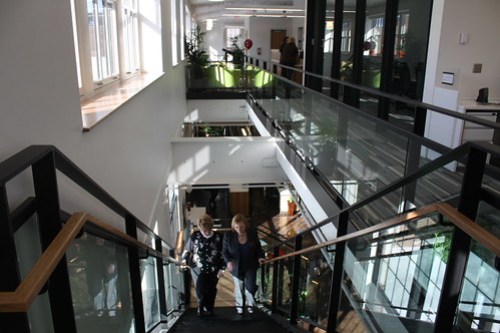
The University of Minnesota, Morris, recently open its new Welcome Center, a major renovation of what had become a sad little building into a shining, spiffy new space. Among other things, it’s a real tribute to the campus’s commitment to sustainability:
When certified, the Welcome Center will be the first LEED Platinum building in the University of Minnesota system; the first LEED Platinum building on the National Register of Historic Places; and one of only thirteen higher education LEED Platinum certified buildings in the world. The Welcome Center is also the first building in Minnesota to use energy efficient chilled beam technology.
They’ve put out a call for art for the building, with a particular interest in work from alumni and others connected to the campus. In a foolish moment, I’ve submitted 20 photos. Now we wait and see if they want to purchase any of them!

I took over 1,000 pictures at yesterday’s 2010 graduation ceremony at UMM, and will sometime be putting the least bad of them on my events account on Flickr, but at the moment I have a ton of deadlines looming (grades, etc.) so that’ll have to wait a bit. The wind ensemble and choir both did … Continue reading "Reflecting on pasts and futures"]]>
Warning: Undefined array key "HTTP_REFERER" in /home/unhinder/www/www/Phi/wp-content/plugins/google-hilite.php on line 58

I took over 1,000 pictures at yesterday’s 2010 graduation ceremony at UMM, and will sometime be putting the least bad of them on my events account on Flickr, but at the moment I have a ton of deadlines looming (grades, etc.) so that’ll have to wait a bit.
The wind ensemble and choir both did an excellent job (as they always do); these are from before the ceremony started while people were filing in and taking their seats. I really loved the reflection in the euphoniums, especially the mirror sharp reflection of the Student Center, trees, and sky in the silver instrument.
I took quite a few pictures of that reflection, and struggled a bit with the final presentation. It’s not clear to me whether the emphasis provided by the desaturation above, or whether I’m better off leaving the color alone (below).
The top one makes a really nice desktop image, by the way :-).

Graduation is an occupational hazard for all teachers from pre-school and kindergarden on up. Here Spring rolls around and another crop of fine UMM students graduate, heading out into that nebulous “the world”. Today I watched another great group of people walk across that stage and shake hands with the assembled dignitaries, and I want … Continue reading "Farewell, and safe voyages"]]>
Warning: Undefined array key "HTTP_REFERER" in /home/unhinder/www/www/Phi/wp-content/plugins/google-hilite.php on line 58
This year’s CSci graduates included students graduating with high distinction, students who’d published their research in major international conferences, done extensive volunteer work, travelled the world, pursued diverse interests, and won highly competitive national awards. Some are going into grad school, some to jobs, some to volunteer work, and some are still trying to figure out the next step. One of the great advantages of a small department is that I’d worked personally with almost all of them on special projects, and had the rest in at least a few classes, and I consider it an honor and a privilege to have gotten to know them.
And that’s just the CSci grads. Another advantage of a small campus is you get to know lots of students in lots of areas. People I knew from the radio station graduated today, along with committee members, musicians, artists, actors, historians, psychologists, biologists, and the lot. This included two Truman Scholars and, as we were reminded today, the only other schools that could boast two Truman Scholars at their graduation this year were Stanford and Wellesley. Not bad for a little school in the middle of nowhere that no one’s ever heard of, eh?
Talking about how great this or that group of students is always sounds dangerously like comparing children, but we just keep getting cool students to work with. This is really the “norm”, whatever that means when both the individuals and groups have such distinct personalities. These folks leave, taking with them a lot of experience and knowledge and enthusiasm, and there’s no doubt that we’ll miss them. There are, however, plenty of great students still on campus, and wonderful new admits that will be joining us in August.
So, best wishes to all this year’s graduates.
Do cool things.
And send us a postcard now and then.
P.S. I’ll try to get the pictures I took today up on Flickr sometime in the next few weeks, but with grading, the May Session course, and being in Ann Arbor the second half of the week, processing all those photos is going to have to wait a bit.
]]>Anyone know why there’s been a sudden spike in searches for “feather braids”? I’ve seen a big spike in views on a photograph I took at the UMM Powwow back in 2007 (see the plot below). When I drill down into the search terms, it’s clear that lots of people are searching for “feather braids”, … Continue reading "Why the sudden interest in “feather braids”?"]]>
Warning: Undefined array key "HTTP_REFERER" in /home/unhinder/www/www/Phi/wp-content/plugins/google-hilite.php on line 58

Anyone know why there’s been a sudden spike in searches for “feather braids”? I’ve seen a big spike in views on a photograph I took at the UMM Powwow back in 2007 (see the plot below).

When I drill down into the search terms, it’s clear that lots of people are searching for “feather braids”, “how to do feather braids” and the like. When I search for “feather braids” on Google, my photo on Flickr is the fourth link, which is presumably why there have been so many hits all of a sudden. I can’t find anything that would explain this flurry of searches, however. Anyone out there in the Hive Mind know what’s driving this?
]]>A recent study for the Department of Education (NY Times piece; full 93-page PDF report) performed a meta-analysis of 99 students over the past 12 years, and found that students in on-line courses did slightly, but statistically significantly, better than those in traditional classrooms. It’s an interesting study, and likely to spur a whole new … Continue reading "Study finds on-line education beats classroom, but what does that mean?"]]>
Warning: Undefined array key "HTTP_REFERER" in /home/unhinder/www/www/Phi/wp-content/plugins/google-hilite.php on line 58

A recent study for the Department of Education (NY Times piece; full 93-page PDF report) performed a meta-analysis of 99 students over the past 12 years, and found that students in on-line courses did slightly, but statistically significantly, better than those in traditional classrooms.
It’s an interesting study, and likely to spur a whole new slew of interest in on-line courses, but it’s really not clear what it means. I’m sure there are a zillion ways I could pull together data showing an education advantage of X over Y, for a zillion Xs and Ys, but one would have to be very careful in the interpretation. I’m willing to bet that most of my colleagues here at UMM would teach better in English than Chinese, and most faculty in China would teach more effectively in Chinese than English, but that hardly means one is a better teaching language than the other. Context is everything, and it’s not clear (at least in the survey study) what the contexts are.
A few possible issues:
- 12 years is an eternity in the history of the web and web-based teaching. Are the studies from 12 years ago even talking about the same things as those now?
- What are we actually comparing? Face-to-face courses have all kinds of variance, and their effectiveness changes with the instructor, the students in a particular running of the course, and external events. Presumably on-line courses will as well. Are we comparing the best to the best? The median to the median? I can easily imagine that an on-line course of a few dozen people can be a vastly better experience than a huge lecture hall of 800 students, even if the latter is still called “face-to-face” instruction. Similarly, one person struggling to manage 150 on-line students is not likely to look good compared to an energetic classroom discussion section of 12 people. The meta-survey doesn’t make it easy to see clearly what the comparisons are in the individual surveys, and I suspect that they probably vary widely, ranging from the pretty reasonable to apples-vs-kumquats.
- How much of this is simply a function of novelty, both in faculty putting a lot of effort into a cool new thing, and students being impressed by the shiny new toy?
Etc., etc., etc.
I think the question isn’t, and can’t ever be, whether on-line is better than the classroom. In the end it’s about finding a way for a particular instructor and a particular student (or group of students) to work well together, and that’s going to depend on an awful lot of things and almost certainly change over time as teachers, students, and the world changes. On-line education and classroom education augmented with on-line components are clearly going to be an important (and probably increasing) part of that, but there will probably always be circumstances where a group of people are better served by some face time than by an on-line experience.
This study also looks at courses as isolated experiences. At a residential university like ours, the courses are crucial, but hardly the whole picture. Students learn a ton from simply living together, eating, doing laundry, volunteering, going to the movies, dating, being in clubs, and generally making all sorts of vital transitions as they move from 18 to 22 (give or take). Look at the important differences between someone’s who’s 16 and someone who’s 26, and an awful lot of that has nothing do to with courses. A good university experience can play a critical role both in and beyond the classroom, and a heck of a lot of that is tied up in physical presence.
]]>